
NEWS
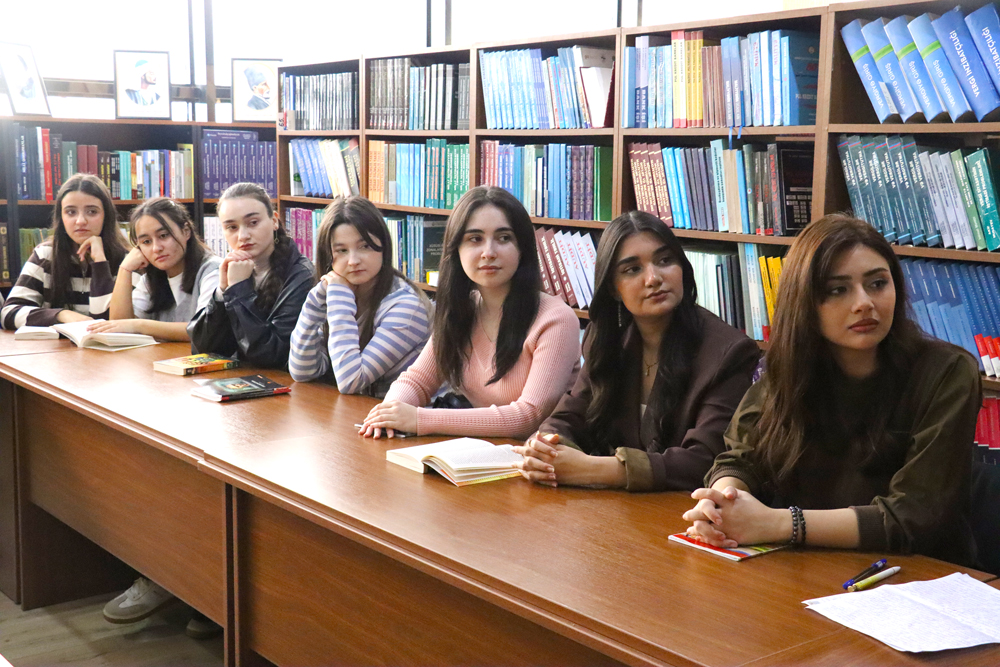
“Voice of Books” reading club members discussed the “Frankenstein” novel
11 december 2025
Baxış sayı: 522
The next meeting of the “Voice of Books” reading club operating under the Department of Translation and Philology was held. The meeting, organized in the University library, was attended by the Dean of the Faculty of Humanities and Social Sciences, Safar Mammadov; the Head of the Department of Translation and Philology, Gulnar Rzayeva; Department faculty members; and club participants. During the meeting, the “Frankenstein” novel by Mary Shelley, one of the most renowned classics of world literature, was discussed.
The event opened with a speech by the Dean of the Faculty of Humanities and Social Sciences, Safar Mammadov. In his remarks, the Dean emphasized the role of reading in shaping academic thinking within higher education. He noted that, beyond expanding knowledge, reading is an indispensable tool for developing critical thinking, analytical skills, and intellectual initiative. Engagement with classical literary works is of great importance for deepening students’ humanities knowledge, broadening their cultural outlook, and enhancing their capacity for active participation in academic discussions.
The Head of the Department of Translation and Philology, Gulnar Rzayeva, also addressed the audience, highlighting that the activities of the reading club are organized in a systematic and purposeful manner. She noted that club meetings are held regularly and take place in various formats. Some discussions are conducted within the University, while others are organized in cooperation with reading clubs from different higher education institutions across the country. The department head noted that such collaboration contributes both to strengthening institutional ties and to expanding opportunities for literary and cultural exchange among students.
Following the speeches, the discussion of the novel commenced. The debate included an exchange of views on topics such as the consequences of the protagonist Victor’s irresponsible scientific ambitions, the relationship between the individual and society, human creativity and the limits of science, as well as the novel’s influence on modern literature and popular culture.
In conclusion, it was noted that the “Voice of Books” reading club will continue to hold regular meetings aimed at fostering reading habits among students, expanding their literary thinking, and cultivating a culture of discussion.
Public Relations Department